Paula has always wanted to visit the wine producing areas of France. She started researching the highlights of the Bourgoyne region (from drinking too much Gallo Burgundy as a lass). She found a Chateau in Beaune which looked charming and would hold the 8 people who committed to the trip.
Early on the afternoon of August 31st, 5 of us left for Beaune via rental car. In my group was Jennifer, one of our friends from Nestle, who did the driving. Also in the car were Jennifer's mom, Kathy, along with her friends, John and Diane.
Because they had to work late, Paula , Ash and Kathy, left later Friday afternoon via rental car.
Beaune, which is a 3.5 hour drive from Vevey, (it is only 3 hrs if you have a decent GPS) is in the Cote d'Or wine region of Burgundy. It
is believed that the area around Beaune has produced wine since 300 AD. The
Catholic church took over wine making in the Middle Ages, finding that Pinot
Noir and Chardonnay flourished in the varied micro climates of Burgundy. Today you'll find wineries and hotels in restored
monasteries- the Catholics on a mission.
Exterior of the Chateau des Barrigards, our home for the weekend.
The caretaker, Pascal, met us as we arrived and took us on a tour of the chateau and showed us how every thing worked. He spoke only a little English, so when we had questions, he would call the owner, who spoke perfect English, and had him call us. Both Pascal and the owner could not have been more helpful in making this a great weekend for us.
According to the owner, when he purchased the chateau it did not have running water, the basement was so small as to be almost useless and most of the rooms were in bad need of repair. He excavated the basement and installed a full bathroom, with shower. He added a large laundry room, that with the use of an aerobed, can function as a bedroom.
On the first floor is the foyer, a large kitchen with a modern high-end gas stove with 8 burners and 3 ovens and other modern appliances, a large parlor with antique furniture and a dining room that seats 8 people very comfortably.
On the second floor are 2 bedrooms, each with its own full bathroom.
On the third floor is the master bedroom with its beautiful blue and white tile and a HUGE bathroom with a claw foot tub, modern walk in shower, double
sinks and a large picture window that looks out over the fields and vineyards
The chateau was built in the early 1900's. The owner e-mailed me a photo of the chateau from an unknown date, but he thinks it is from the 1920's.
 On your way to dinner we past the Notre Dame Cathedral of Beaune.
Built
in the Romanesque and Gothic styles from the 11th to 15th centuries, this church
was once affiliated with the monastery of Cluny. It's notable for its
extra-large porch, and medieval tapestries are displayed inside from Easter
till the third weekend in November.
On our way back to our car after dinner
we again passed the Notre Dame Cathedral. After
dark, the facade becomes a spectacular display of light and color. Note -
this is just one picture, the display actually shows many other rotating scenes.
Friday night dinner, in the vaulted stone cellar, at Abbaye De Maizieres. Counter-clockwise, John, Paula, Ash, Kathy, Jen, Jim, Diane and Kathy (Jen's mom).
The Abbaye de Maizieres is
a 12th-century former Cistercian Abbey, located in the heart of the historical center of Beaune.
As we were sitting around the table after dinner, it was decided that because the kitchen, at the chateau, was so functional and the chateau itself was so beautiful, that we would cook dinner, Saturday night, rather than go out to a restaurant.
We divided into 4 teams. John and Diane would handle appetizers. Kathy (from Nestle) and I would do the salad. Ash, Jen and Paula would prepare the main course. Kathy (Jen's mom) and Ash would handle dessert.
Beaune has a great Saturday open air market. So we decided to purchase everything, for the dinner, from the market.
 On the way to the market, we passed one of the many beautiful parks in Beaune.
A serious butcher knife.
The Saturday market, in addition to having a vast array of produce, also has a meat market with varied selections.
One of the most interesting shops was where they sold fresh chickens. As you can see they have both the head and feet still attached.
Before you purchase the chicken, the butcher removes both the head and the feet.
After a bite of lunch, we met up with our tour guide for the wine country. Who should our guide be, none other then Laurence, our waitress from the Abbaye de Maizieres. Here she is explaining about the vines and the type of soil that they grow in. As you an see the soil is not very good. Mostly a mixture of clay and limestone, but it grows great grapes for wine. Laurence is very knowledgeable in regards to the wine industry in the Cote d'Or region.
This sign indicated that this vineyard belongs to the Hotel-Dieu (The Hospice of Beaune). I will talk more about the importance of the Hospice later in the blog.
In the Beaune area there are acres and acres of vineyards. In most case, the same vineyard will be owned by different families. Each family is responsible for maintaining the vineyard and the harvesting of the grapes. The grapes are harvested by hand. They make it a very festive occasion. People will take vacation to help out with the harvest. When necessary they hire college kids to assist.
The grapes are almost ready for harvest It has not been a good year for growing grapes, as Beaune has had a lot of rain.
Paula and I are viewing more vineyards.
Near the central square of
Puligny-Montrachet, (a small village about 5 miles south of Beaune), bronze a sculpture of winemakers represented in their various
work in the vineyard.
When we completed our tour of the vineyards, Laurence took us to the Chateau De Meursault for wine tasting. We were allowed to taste 3 white wines and 4 red wines.
The Chateau De Meursault is one of the most
visited estates in Burgundy. It has been producing wine for over a 1,000 years.
It welcomes around 20 000 visitors per year who come to taste and buy the wine.
The cellars, which lie under the
Chateau and its outbuildings, some of which were excavated in part
by the monks of The Abbey Cîteaux, in the 14th and
16th centuries, can contain up to 700 000 bottles and more than 2
000 barrels. The Chateau owns
about 150 acres of vines (Chardonnay for the whites and Pinot Noir for
red). These are the only two varietals, which have made the reputation of
Burgundy’s great wines.
Typical of the vineyards in the Burgundy area,
the 150 acres consist of more than 100 different parcels of vines located
within an average of 6 miles from the Chateau. The smallest vineyard is 119 square yards and the largest is
20 acres. Nearly all of their
grapes are organically grown.
According to the Sommelier, at the Chateau, the corks must be changed every 15 years. He stated that the wine will hold its flavor for many years when handled correctly.
This cellar has over 2,000 barrels of wine. In order to keep the correct temperature, they close the cellars to the public for 2 hours every day and turn on the air condition system to lower the temperature in the cellars.
Here Laurence is telling us about one of the wines. We bought a few bottles to serve during our Saturday dinner and to take back to Vevey. You are only allowed to enter Switzerland with two bottles per person, we purchased our limit.
We arrived back to our Chateau and started to prepare our Saturday night feast.
John and Diane put together this appetizer. It consisted on three different types of cheeses which could be spread on a fresh baguette. It also included fresh figs, a varied selection of olives and fava beans. They topped it off with some of the best tasting grapes we have had since moving to Switzerland.
Paula is inspecting the table to ensure that all is in order.
This is the salad course that Kathy and
I prepared. On a bed of fresh lettuce we layered chopped fennel, chopped
apples and a little fresh parsley. We then topped it with a variety of
seeds. The dressing was comprised of Dijon mustard laced with figs, olive oil, herb
vinegar, lemon juice and a little sugar. Once we drizzled the dressing
over the salad, we added a little goat cheese to top off the salad.
This is the main course prepared by Jen, Ash and
Paula. It was veal wrapped with bacon. Jen and Paula had quite the
experience at the butcher shop. Once they purchased the veal and the
bacon, they tried to explain to the butcher that they needed some string to tie
the bacon to the veal. He just could not seem to understand what they
wanted. Finally after much pantomime they were able to get him to
understand. He took back the veal and bacon and told then to come back in
5 minutes. When they returned, the butcher had tied the bacon on to the
veal.
Also included in the main course was thinly sliced potatoes and zucchini
which were then covered in a cheese sauce and baked until the cheese was bubbly
and brown. They called it a vegetable gratin. On the side of the
meal was a mysterious medley of assorted sauteed mushrooms.
The dessert was prepared by Ash and Kathy. It consisted on a type of cheese cake. On top they added fresh strawberries, raspberries and blackberries. Over all of this they drizzled lightly sweetened creme fresh.
Here we are enjoying a final glass of wine.
These are the wines that we served with the feast.
On Sunday morning we had to leave the Chateau. As you can see we were a very happy group as we had a delightful time.
Kathy (who took this last shot) is the one who best characterized what is what like to be in such a magnificent chateau and wake up with friends all around. She stumbled out into the kitchen after the first night asking, "Did Santa come?" That says it all.
We are on our way to Beaune to visit the Hotel-Dieu (The Hospice of Beaune).
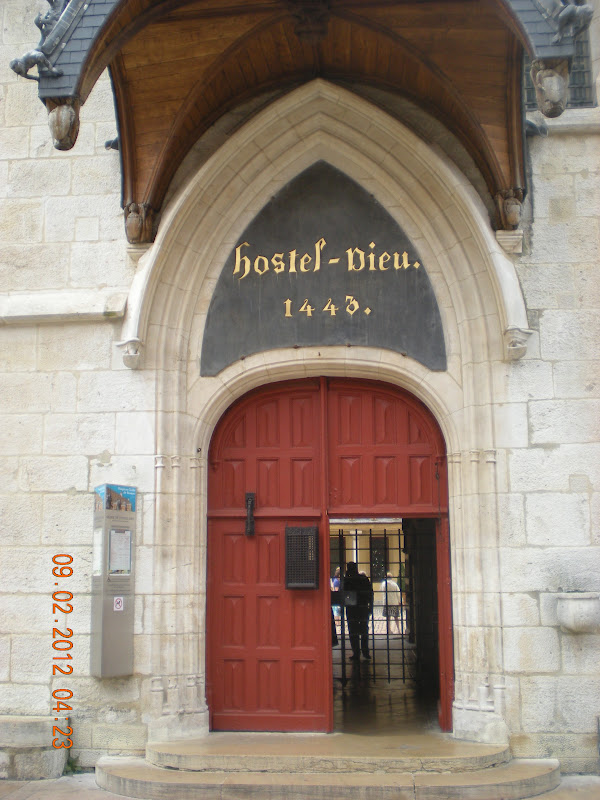
Hotel-Dieu (The Hospice of Beaune).
The Hotel-Dieu was founded on August 4,1443,
when Burgundy was ruled by Duke Philip the Good. The Hundred Years' War had recently been brought to a close by the signing of the Treaty of Arras in 1435. With the signing of the treaty, the duke of Burgundy and the king of France had united to expel the English, but in doing so they had unwittingly created an even deadlier foe. The disbanded soldiers formed themselves into companies of thieves who terrorized the countryside to such an extent that the peasants were obliged to abandon their fields and take refuge in the fortified towns and chateaus. The abandonment of the crops bred famine and famine bred pestilence. The poor were dying by the thousand. Beaune was at this time one of the hardest-hit areas in Burgundy
The majority of the people of Beaune were declared destitute. Nicolas Rolin, the Duke's Chancellor, and his wife Guigone de Salins, reacted by deciding to
create a hospital and refuge for the poor. The outside of the Hotel-Dieu is decidedly plain, reflecting its somber mission and making the complex less attractive to thieves. But once inside, the colorful tile roof reflect the wealth of the inordinately generous ruling class. The Hotel-Dieu is now a museum
The Hotel-Dieu received the first
patient on January 1, 1452. Elderly, disabled and sick people, with orphans,
women about to give birth and the destitute have all been uninterruptedly
welcomed for treatment and refuge, from the Middle Ages until it was closed to patients in the early 1970's.
Over the centuries, the hospital radiated
outwards, grouping with similar establishments in the surrounding villages of Pommard, Nolay and Meursault. Many donations - farms, property, woods, works of art and of course vineyards -
were made to it, by grateful families and generous benefactors. The institution
is one of the best and oldest example of historical, philanthropic, and
wine-producing heritage, and has become linked with the economic and cultural
life of Burgundy.
In order to support the Hotel-Dieu’s museum, a charity
wine auction is held the third Sunday in November. The auction has been held annually since 1851. The wine that is auctioned comes from the 150 acres of vineyard land owned by the Hotel-Dieu, a non-profit
organization.

The Hotel-Dieu’s striking geometric glazed-tile roof
makes this a standout external feature of the building. The courtyard is the
best place to admire the tapestry of interwoven red, green, brown and yellow
glazed tiles. This type of roof is a hallmark of the Flemish-Burgundian architecture
of the middle ages, and is seen quite often in this part of Burgundy.
The Hotel-Dieu Clock/Bell Spire - 165 feet tall.
The Room of the Poor
The room measures 165x46x53 feet.
On the ceiling, the visible painted frame is in an upside down boat-skiff shape and in each beam
are sculpted caricatures of some important Beaune inhabitants. On the
floor tiles are written Nicolas Rolin's monogram and his motto “Seule etoile” (only star) referring to his wife, Guigone de Salins. He referred to her as “The only star of my heart.” That's just what I always say about Miss Paula.
The room is
furnished with two rows of curtained beds. Each bed could hold two patients. The central area was dedicated to
benches and tables for the meals.
At the back of the large ward is
the Chapel. The place for the chapel was chosen to allow the bedridden to
attend Mass from their beds, which was conducted every 3 hours.
A close-up of one of the 28 beds that lined the sides the Room of the Poor. (There were 14 beds on each side of the room). Each bed had a curtain in front for privacy. Behind the beds, was a walk way which allowed the nuns to treat their patients in privacy. During epidemics, there were two patients to a bed. Rolin believed every patient deserved dignity, thus he provided each patient with their own a pewter jug, mug, bowl and plate. The room did not have central heating until the 19th century.
The stained glass window in the chapel.
The Hotel-Dieu was not a place of hope. People came here to die. Care was more for the soul than the body.
The stained glass shows Nicolas Rolin (lower left) and his wife, Guigone (lower right), dressed as a nun to show her devotion. Nicolas' feudal superior, the Duke of Burgundy, is portrayed above him. The top part shows Jesus' crucifixion. The souls of the two criminals crucified with him (portrayed as miniature naked humans) are being snatched up, one by an angel and the other by a red devil. At the bottom, Mary cradles the dead body of Christ.
The alter in the chapel.
The remains of the Guigone de Salins are buried here.
St Hugue Ward.
In the 17th century, this smaller ward was established for wealthy patients (who could afford better health care). They were more likely to survive, and the decor displays themes of hope, rather than resignation to death. The series of baroque paintings lining the walls show the biblical miracles that Jesus performed. As the wealthy would lie in their beds, they would stare at the ceiling of a painting of an angel's foot, surrounded by the sick waiting to be healed by Jesus.
The Kitchen.
The 19th century stove provided running hot water, which spewed from the beaks of swans made out of copper.
The Last Judgment
This is the most highly treasured article in the Hotel Dieu. In 1450, Rolin commissioned Roger van der Weyden (a Flemish artist) to paint this picture for the altar in the Room of the Poor. At some point the painting was moved from the alter and today it is installed in a climate controlled room, to prevent additional deterioration.