Thursday, June 14, 2012

A day in Lyon, France

When Paula and I were in Vevey, last December, for her pre-visit to Nestle, we took the train to Lyon, France to see their Festival of Lights (more on that festival later).  We had such great food that we promised ourselves that we would re-visit Lyon when we got the opportunity.  We fulfilled that promise, with a visit on the weekend of June 2nd and 3rd.


Arriving at the Lyon Train Station.


Lyon is located approximately 292 miles from Paris, 199 miles from Marseille and 99 miles from Geneva.  Two major rivers, the Rhone and the Saone, runs through the town.  The residents of the city are called Lyonnais.  It is the second largest city, in France, with a metropolitan population of over 2 million inhabitants.

In 43 BC the Roman military colony of Lugdunum (Lyon) was founded on Fourviere Hill, which now overlooks the present city from the west.  It served as the capital of the Roman territories known as the Three Gauls under Augustus, but had to wait until the 15th century for fame and fortune to strike.  With the arrival of move able type in 1473, Lyon became one of Europe’s foremost publishing centers, with several hundred resident printers contributing to the city’s extraordinary prosperity.

By the mid-18th century, the city’s influential silk weavers – 40% of Lyon’s total workforce – transformed what had already been a textiles center since the 15th century into the silk-weaving capital of Europe. By the early 19th century, Lyon had tripled in size, boasting a population of 340,000 people and 100,000 weaving looms.  

In 1870 the Lumiere family moved to Lyon, and sons Louis and Auguste shot the first moving picture – of workers exiting their father’s photographic factory – in 1895. Cinema’s birth was an instant winner.

During WWII some 4,000 people (including Resistance leader Jean Moulin) were killed and 7,500 others deported to Nazi death camps under Gestapo chief Klaus Barbie (1913–91), the ‘butcher of Lyon’. Nazi rule ended in September 1944, when the retreating Germans blew up all but two of Lyon’s 28 bridges. A Lyon court sentenced Barbie to death in absentia in 1952 and again in 1954, but it was not until 1987, following his extradition from Bolivia (where he had settled after WWII), that he was tried in person in Lyon for crimes against humanity and sentenced to life imprisonment. The 72-year-old died in prison three years later.

The international police agency Interpol has been headquartered in Lyon since 1989.

Today, the city has developed a reputation as the capital of gastronomy in France. The city is also known for its famous light festival "Fete des Lumieres" which occurs every December 8th and lasts for four days, that earned Lyon the title of Capital of Lights (not to be mixed up with Paris the city of light). Over 4 million people attended last years' festival.


To get to our hotel, we walked along the Rhone River.  Near the bank was this family of swans.  You can see the two baby swans in the middle of the picture.


Lyon is considered to be the "Capitale de Gastronomique" of France with 2 principal approaches to dining. First is classic French cuisine featuring the complex sauces and formal presentation. The second important approach to dining out is at a restaurant called a Bouchon. These are generally small places that do a great job with peasant food. Le Bon Bourgeois, is such a place, where we enjoyed salade Lyonnaise, escargot, goat cheese, lemony pasta and other simple, yummy stuff. 


Bon Appetit

Cathédrale Saint-Jean-Baptiste de Lyon (St John’s Cathedral of Lyon).
This Roman Catholic cathedral was founded by Saint Pothinus and Saint Irenaeus, the first two bishops of Lyon. It is the seat of the Archbishop of Lyon. The cathedral is also known as a "Primatiale" because in 1079 the Pope granted to the archbishop of Lyon the title of Primate Of All the Gauls with the legal supremacy over the principal archbishops of the kingdom.
Begun in the twelfth century on the ruins of a 6th century church, it was completed in 1476. The building is 265 feet long (internally), 66 feet wide at the choir, and 107 feet high in the nave.
Noteworthy are two crosses to right and left of the altar, preserved since the council of 1274 as a symbol of the union of the churches, and the Bourbon chapel, built by the Cardinal de Bourbon and his brother Pierre de Bourbon, son-in-law of Louis XI, a masterpiece of 15th century sculpture.
The cathedral also has a working 14th century astronomical clock (a clock with special mechanisms and dials to display astronomical information, such as the relative positions of the sun, moon, zodiacal constellations and major planets.)

Until the construction of the Basilica of Notre-Dame de Fourviere, it was the pre-eminent church in Lyon

We traveled to Lyon with a few of our friends from Nestle, from left to right, Ash, Patty, John, Paula and Kathy.


Basilica of Notre-Dame de Fourviere.


The entrance to the Basilica of Notre-Dame de Fourviere.


From the base of Fourviere Hill we too a funicular to visit this church.  As you exit the funicular, this is the view of the church.


Construction was started in 1872 and finally completed in 1884. It has four main towers, and a bell tower topped with a gilded statue of the Virgin Mary. It features fine mosaics, superb stained glass and a crypt of Saint Joseph. 


Fourviere actually contains two churches, one on top of the other. The upper sanctuary is very ornate, while the lower is a much simpler design.


The Basilica is dedicated to the Virgin Mary, who not only saved the city of Lyon from a cholera endemic sweeping Europe in 1823, but during the Franco-Prussian War (1870-1), Prussian forces, having taken Paris, were progressing south towards Lyon. Their halt and retreat were attributed, by the Church, to the intercession of the Virgin Mary.
Perched on top of the Fourviere hill, the basilica looms impressively over the city of Lyon, from where it can be seen from many vantage points;  the basilica has become a symbol of the city.


It has four main towers, and a bell tower topped with a gilded statue of the Virgin Mary. It features fine mosaics, superb stained glass and a crypt of Saint Joseph.
Fourviere actually contains two churches, one on top of the other. The upper sanctuary is very ornate, while the lower is a much simpler design.


Paula and Ash descending the stairs to the lower sanctuary.


Lower sanctuary.

Lower sanctuary.

Upper sanctuary.


Standing to the right of the basilica is the Chapel of the Virgin Mary.


In 1168, a chapel was built to Our Lady on the hilltop of Fourviere. This chapel was destroyed in 1562 by the Baron des Adrets (a notorious persecutor of catholics) but the chapel was soon rebuilt.  As a side note, Baron des Adrest converted to Catholicisms before his death in 1587. 

Marian devotion continued to develop in Fourviere, becoming especially popular when in 1638 King Louis XIII consecrated France to the Virgin Mary

In 1643 the people of Lyons consecrated themselves to Our Lady Fourviere and pledged themselves to make a solemn procession on September 8th of each year, in thanksgiving for her saving the city of Lyon from a cholera endemic. On that day, the people make a present to the Virgin of a seven-pound candle and a gold coin. This annual procession continues to this day.

In 1830, the steeple of the chapel was deemed to be in poor condition and unsafe, and it was demolished. It was then decided that a golden statue of Mary would be added to the re-built steeple. The inauguration of the renovated chapel was initially scheduled for September 8, 1852, feast of the Nativity of Mary, but heavy rains instead flooded the foundry where the statue was stored, causing the inauguration to be moved to December 8th.

The statue was installed but again the weather was uncooperative, so the planned fireworks and festivities had to be cancelled. The people of Lyon, undismayed by this, put out lanterns on their windowsills when the rain abated later in the evening, as a sign of their devotion. This episode is at the origin of the street illuminations of December 8th, an annual tradition in Lyons nowadays.

A view of Lyon from Fourviere Hill with the Saone River in the middle.


The Roman ruins on Fourviere Hill.

The Lyon Amphitheater, pictured above, is often referred to as the Amphitheatre des Trois Gaules (or Amphitheater of the Three Gauls), is among the oldest ruins to be unearthed in France.  

Another view of the Roman ruins.


La Fontaine Bartholdi.

According to many travel web sites, this is one of the most famous statues in all of France.

This massive bronze structure, which sits in front of Lyon’s City Hall, was designed by Frederic Bartholdi in 1888, two years after he completed work on the Stature of Liberty.

The fountain depicts France as a female seated on a chariot controlling the four great rivers of France; Seine, Loire, Rhone and Garonne represented by wildly rearing and plunging horses, highly individualized but symmetrically arranged, with bridles and reins of water weeds.  The statue weighs 21 tons and is made of lead supported by a frame of iron.


The classic French dining experience at Chef Paul Bocuse Bistro, Le Sud.


Bon Soiree!

Friday, June 1, 2012

Dewar Family Visit

The Dewar family, from Denver, our daughter Heather, son-in-law Scott and our grand kids Lindsay and Logan visited us from Friday, May 18th through Monday, May 28th.  As you will see in the following pictures we had a great time.  However, the visit was all too short.

Arriving at the Geneva airport to be greeted by Paula and me.  They departed Denver at 11:20 am, on Thursday, via United Airlines.  Arrived in Montreal, Canada at 4:48 pm and arrived in Geneva at 11:30 am Friday.  They look pretty good for flying that long.

Once we arrived in Vevey, we took them to the waterfront, so they could clear their jet lag.  One of the most fun activities, for the kids, was skipping rocks on Lake Geneva.


We had been collecting stale bread so they could feed the swans and ducks on the lake.


Happy recipients of the bread.


While walking around Vevey, we passed the statue of Charlie Chaplin.  L & L did not know who he was, but wanted their picture taken with him anyway of course. 


Paula and L & L in front of the fork that sits in Lake Geneva, in front of the Alimentarium (Museum of Food) sponsored by Nestle.


As we continued our walk, we visited one of the many fountains in Vevey.


On Saturday, we visited the Alimentarium.


In addition to the many food exhibits, the museum also has an area set aside when people can interact, in order to learn how exercise can help keep one fit.


This exhibit allows you to to determine how much exercise is required to offset the eating of different foods.   One of the major themes of Nestle is "Good Food, Good Life".


We are on our way to the Chateau Chillon (The Chillon Castle) via a boat from Vevey.  The trip takes less than 30 minutes and you get a great view of Vevey from the water.


A picture of the Chillon Castle from Lake Geneva.  The oldest parts of the castle have not been definitively dated, but the first written record of the castle is in 1005.  From the mid 12th century, the castle was home to the Dukes’ of Savoy, and it was greatly expanded in the 13th century by Duke Pietro II. The Castle was never taken in a siege, but did change hands through treaties.


It was made popular by Lord Byron who wrote the poem, The Prisoner of Chillon (1816) about Francois de Bonivard. Bonivard (1496-1570) was a Swiss patriot and political activist. He opposed the Duke of Savoy in his efforts to control Geneva; the duke captured Bonivard and imprisoned him from 1519 to 1521. The experience was not much of a deterrent; Bonivard continued his political activism. In 1530, he was set upon by robbers who eventually turned him over to the Duke of Savoy. In 1530 the duke imprisoned him again, this time underground in the Castle of Chillon.  He was released by the Bernese Army when they conquered the canton of Vaud in 1536.
According to the castle website, Chillon is listed as "Switzerland's most visited historic monument".

Arriving at the castle.


The castle puts on many activities through out the year.  This weekend they had a demonstration on how food was cooked in medieval times.  In this picture, Paula is cooking a sausage over an open fire. Look forward to doing the same at 4th of July at Cannon Beach.


The Dewar family cooking their hot dogs and sausages.


On Sunday we took the train to Rochers-de-Naye to see the marmots for which it is famous.  Rochers-de-Naye is about a one hour train ride northeast of Vevey, at an elevation of 6,710 feet.


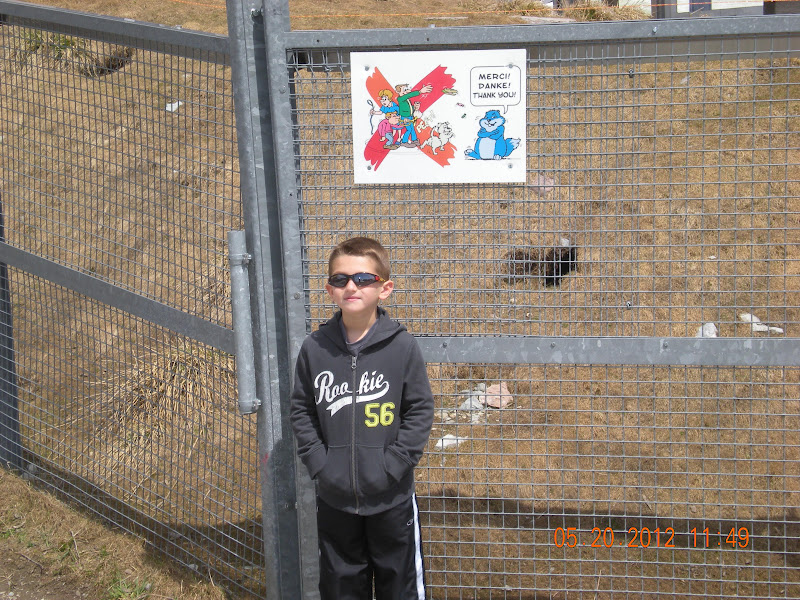
Logan standing in front of the sign that says "Do not feed the Marmots".  In the middle of the picture you can see the hole that was made by the marmots.  We did not see any marmots in this enclosure.

This picture was taken looking north from Rochers-de-Naye. Look at L&L...you've seen one Alp, you've seen them all.


We are hiking through the snow to another area where there was suppose to be marmots.  Once we reached the area we saw a sign that stated that the marmots had been temporally moved.  So, we never did get to see any of the little creatures.


A picture from the top of Rochers-de-Naye, with Lake Geneva is in the background.

We could not see any marmots, so we decided to eat lunch.  It was great food which we topped off with dessert.  Pictured is the dessert ordered by Heather.


The train from Rochers-de-Naye stops at Montreux so passengers can transfer to other trains.  It was still early so we decided to visit the Montreux waterfront before going back to Vevey.


More " tree art" along the waterfront.

On Monday, we took the Chocolate Train to visit the Gruyere Cheese Factory and to Broc to visit the Cailler (cay yea) Chocolate Factory.


The interior of the vintage train car that we took.


At the Gruyere Cheese Factory we saw how the cheese was made.  These are just a few of the large copper containers that are used in the process.


L & L are standing in front of the "cave" where the Gruyere Cheese is allowed to age.  There is a machine, with a robotic arm, that travels up and down the aisles turning the cheese on a periodic basis.  It was really interesting to watch.


The town of Gruyere.


While we were visiting the town of Gruyere, I walked into this small cheese shop.  The proprietor was making Gruyere Cheese the same way as the factory, but obviously on a much smaller scale. Notice the copper kettle.


Our next stop was the Cailler Chocolate Factory where we took a tour to see how their chocolate is made.


At the end of the tour is a tasting room, with a large "U" shaped table, that is loaded with various types of Cailler Chocolates.  Lindsay was in chocolate heaven.  She takes after her Papa as a consummate chocolate lover.  Logan, on the other hand, could not care less about chocolate and was forced to eat gummy bears. 

On Tuesday, Paula took the Dewar's on a tour of the Nestle Headquarters, met her co-workers and then took us to lunch in the Nestle cafeteria.  Nestle has its own staff of chefs and the food is excellent.  It is the highest volume restaurant in Switzerland and great food in Vevey.


After the tour, Heather and Scott headed to the train station to catch a train to Geneva Airport so they could fly to Paris.  They were in Paris from Tuesday afternoon, arriving back to Vevey late Friday night.  This gave Paula and me a chance to show L & L around Vevey and the surrounding areas.

Lindsay ask to see a zoo during their visit.  On Wednesday I took them to the Servion Zoo.  It is located about 20 minutes east of Lausanne, by train.


In front of the reindeer.

In the background are Pygmy goats.  As is was early in the year, we got to see a lot of baby animals.  They really enjoyed watching the baby goats climb on the logs and then start butting heads, trying to knock each other off the log.


At the zoo there was a large play area.  The kids really enjoyed riding the zip line.


Another zip line ride.


Next to the zoo was a Tropical Aquarium.


One of the many animals on exhibit.  I mean the crocodiles in the background.  


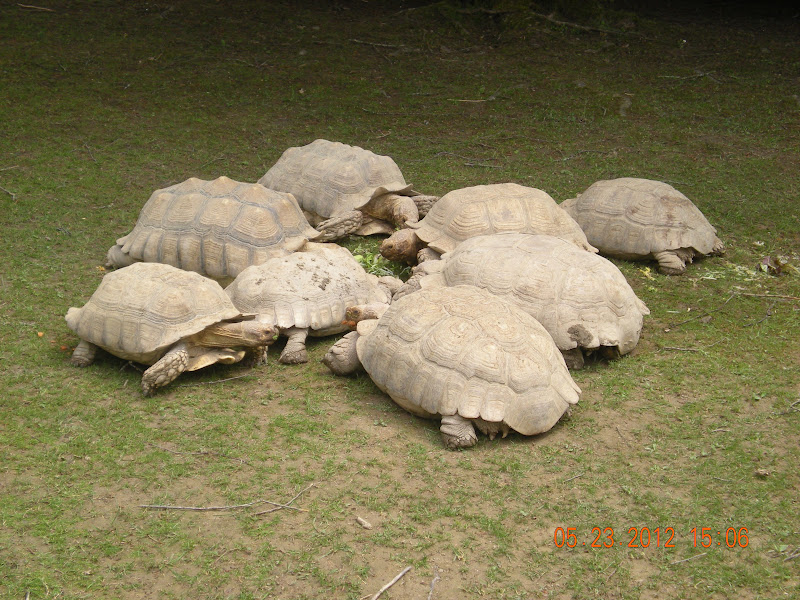
We were there during feeding time. As you can see there are many large tortoises eating their lunch.  What you don't see is way in the background was a baby tortoise.  He was slowly and I mean very slowly crawling towards the food.  We watched for a long time and finally he just gave up and crawled slowly back to his pen.  The kids thought this was very interesting.

At the Vevey train station on Thursday morning.  We are taking the train to Lac Souterrain-St. Leonard to visit a cave that contains the largest underground lake in Europe.  The cave is located about 1 and 1/2 hours, by train, east of Vevey.


Arriving at Lac Souterrain-St. Leonard.  It is about a 15 minute walk from here to the cave.


The only way to visit the cave is by boat.  So we signed up for the guided tour and headed into the cave.

The lake, with a length of 985 feet, a width of 66 feet and an average depth of 40 feet, it is the largest underground lake in Europe.  It was discovered in 1943, but the entire cave was filled with water and could not be explored.   In 1946, an earthquake opened additional fissures in the cave, which allowed most of the water to drain out, thus allowing the cave to be explored.  In 1949 it was opened to the public.  Its water is a constant 52 °F. 


L & L inside the cave.


The weather on Friday was absolutely gorgeous.  So we decide to take a boat from Vevey to Le Bouveret to visit the water park.  In the background is the arriving boat that will take us to the park.


Rock Stars on the boat to Le Bouveret.

Approaching the town of Le Bouveret.


Arriving at the Aqua Park.


About every 30 minutes, they would generate large waves in the pool, which lasted for about 10 minutes.  I could not get a good shot of the waves, but the kids really enjoyed them.  You can see one of the waves beginning to form at the left side of the picture. They spent hours in this pool.


The park was a ride called the "Lazy River".  It is an oblong Kidney-shaped concrete structure, about 300 feet in circumference, 10 feet wide and 3 feet deep. The "Lazy River" generates a fast moving current and Logan used a inner tube to navigate the river.


Lindsay in her tube.


Back at the dock at Le Bouveret to take the boat to Vevey. The boat was suppose to be at the dock at 6:00 pm, however, for some reason it was closer to 6:45 before it arrived.  To keep busy, the kids played games on the dock railings.


On Saturday morning we took a boat from Nyon, Switzerland to Yvoire, a small medieval French town.


Arriving in Yvoire.


The flowers, at this time of year, were absolutely beautiful.


L & L in front of some more beautiful flowers.


The Dewar's in Yvoire.


Paula and Logan in one the "Nine Gardens".  In the middle of Yvoire is this area of 9 gardens.  The gardens were established in medieval times to grow food for the nearby Yvoire Castle.  The gardens have been restored and opened to the public.  Each garden has different plants and flowers.  In some of the gardens you are encouraged to feel and smell the plants.


Scott and Lindsay visiting one of the gardens.

The Dewar family by the Yvoire waterfront.


The Yvoire Castle with beautiful roses in the foreground.


L & L's 2 favorite activities, feeding the ducks and skipping rocks.


On the boat heading back to Lyon and then Vevey.

Sunday was the last full day of their visit, so we decided to stay close to Vevey so as not to tire out the kids for the long trip back to Denver.


Vevey has a very nice pool which is about a 10 minute walk from our apartment.  The kids played in the pool for quite a long time.


Our last dinner together.


Lindsay has her 8th birthday on May 31st.  Even though it was May 27th, we decided to celebrate her birthday early.

It was quite an experience for Paula and me to order the cake.  With Paula's French language skills and a lot of pointing, we finally ordered a cake that had a picture of "Hello Kitty" and said Happy Birthday.

While in Yvoire, Lindsay admired a bracelet.  Paula went back to the shop and brought it for her birthday.


On Monday morning we all took the train to the Geneva Airport.  It was a sad day for all of us having to say good-bye.